Market Report · 2026
The Super Clone Watch Market Report 2026
The first data-driven look at the super-clone segment — the numbers no one else publishes. Prices, the factory quality index, demand, and how buyers actually behave.
By Julian Hofer · Updated 2026-06-09 · Based on a 507-product catalog analysis, a 110-reference factory database, and US search-demand research.
By the numbers
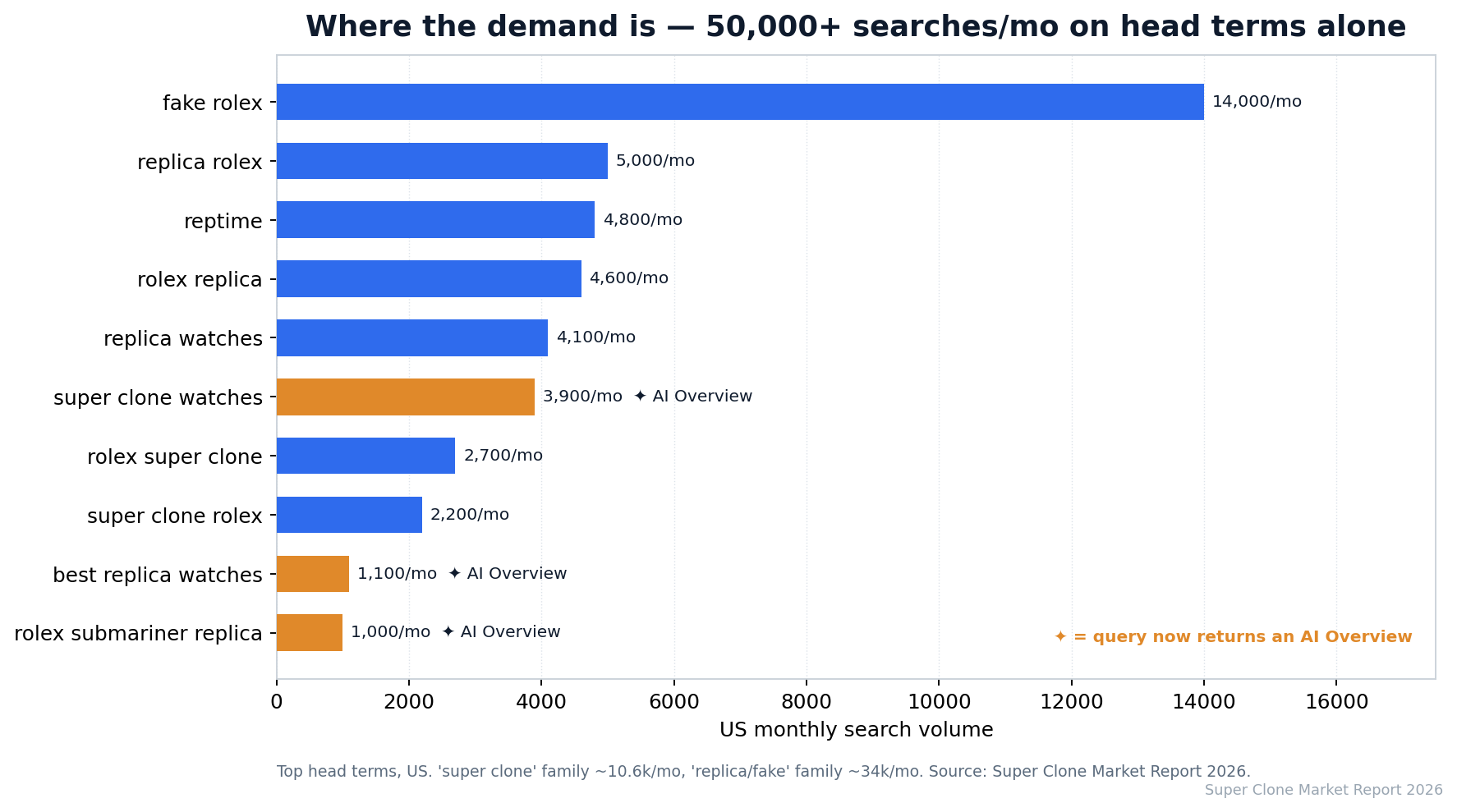
- The super-clone segment draws 50,000+ US searches per month on head terms alone.
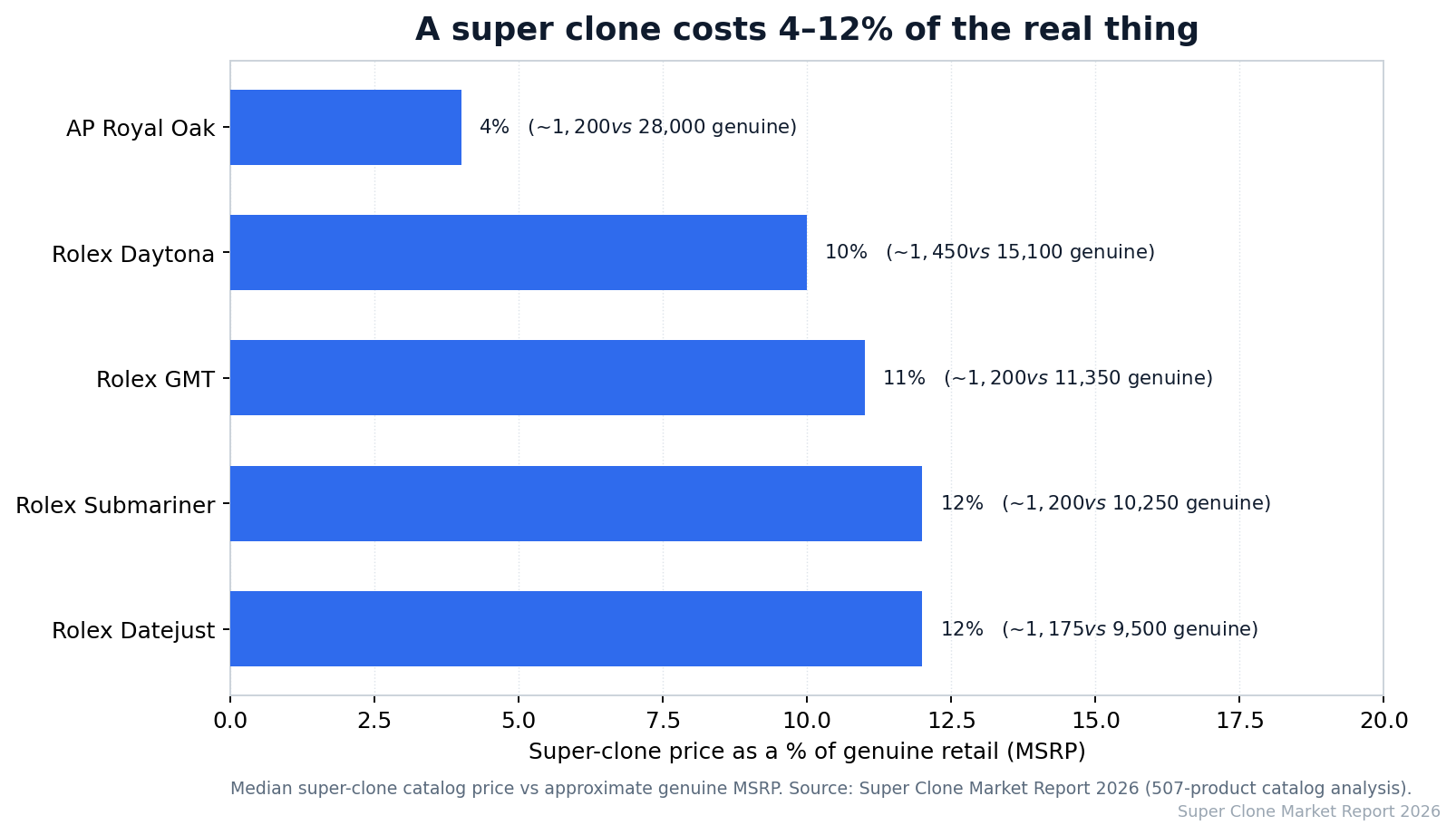
- A super clone sells for just 4–12% of the genuine watch’s retail price — a median of ~$1,250 vs. thousands.
- The median super-clone Rolex is ~$1,400; the Daytona is the most expensive at ~$1,450.
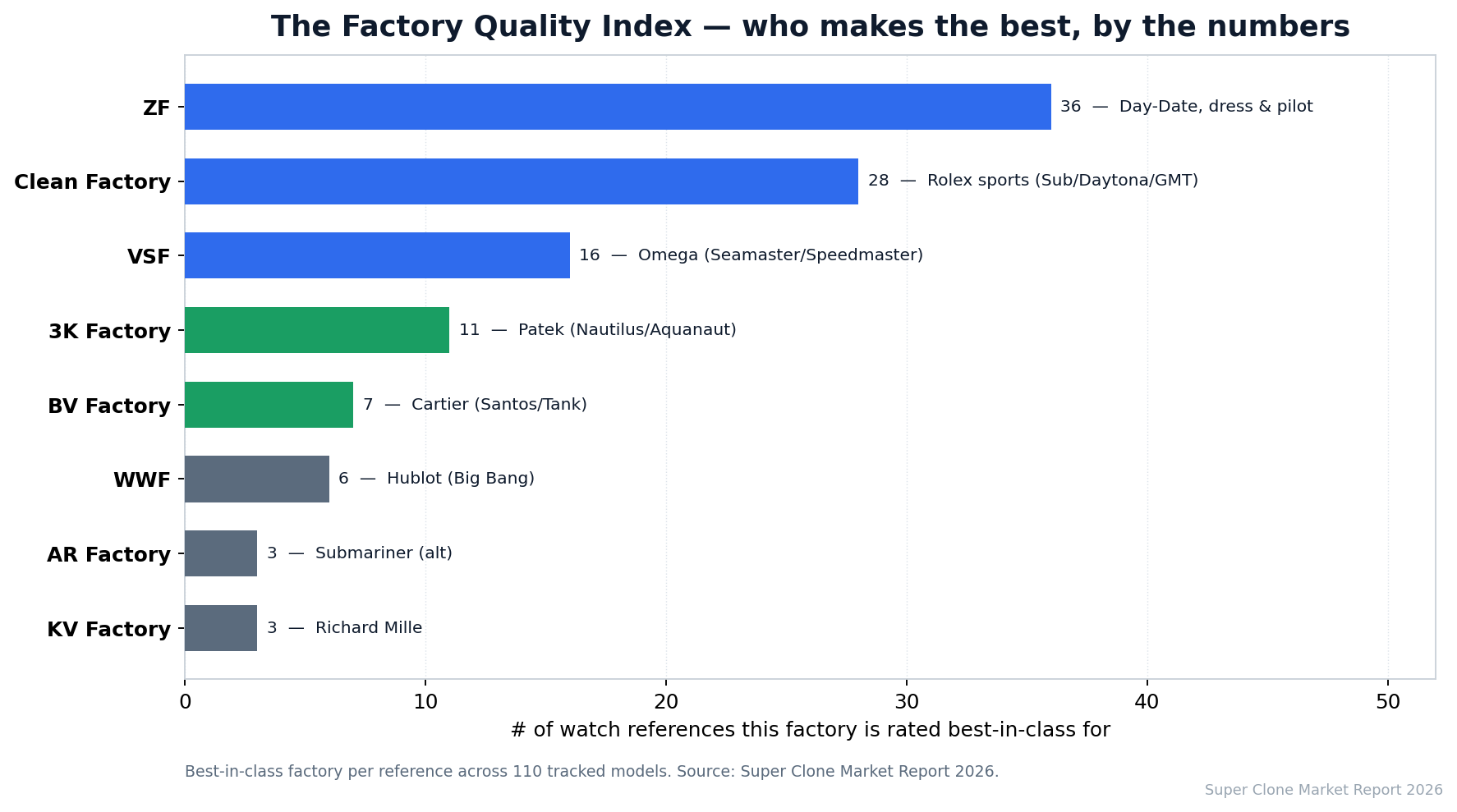
- ZF and Clean Factory lead the market — rated best-in-class for 36 and 28 references. Clean Factory owns Rolex sports, VSF owns Omega, 3K owns Patek.
- Nearly one-third of top buyer queries (10 of 33) now return an AI Overview.
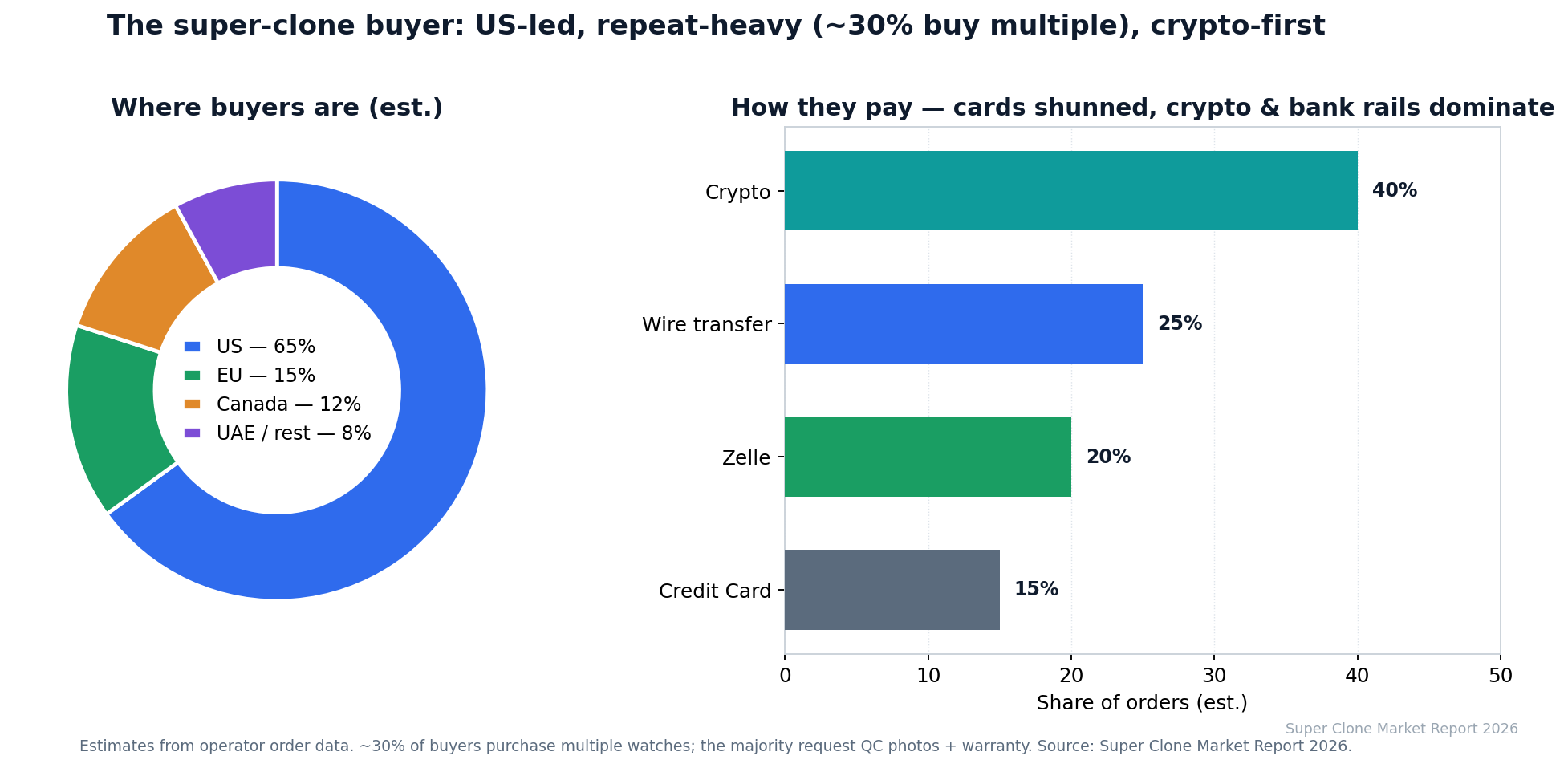
- Around 30% of buyers purchase multiple watches — a collector/repeat rate far above mainstream retail.
- Crypto and bank transfer dominate payment (~40% crypto, ~25% wire); credit card is a minority as processors shun the niche.
- Chargebacks are a customer-selection problem, not a payments one — vetted sellers run near-zero despite high niche-wide fraud.
1. Market & demand
The super-clone / replica-watch market is large, search-led, and increasingly researched through AI. The top 33 head terms alone total about 52,200 US searches a month; the full long tail multiplies that several times over.
The “super clone” family (~10,600/mo) is the rising premium descriptor alongside the larger “replica / fake” family (~34,000/mo). Ten of the 33 head terms now trigger a Google AI Overview — buyers increasingly get an AI-summarized answer before they ever click.
2. The most-wanted models
Rolex is the engine of the segment — an estimated 60% of super-clone sales — with Audemars Piguet (~12%) and Patek Philippe (~8%) the next tier. The top-selling Rolex models are the Datejust, Submariner and Daytona, followed by the GMT-Master II and Day-Date. For AP, the Royal Oak leads; for Patek, the Nautilus dominates.
3. The price landscape
Across a 507-product priced catalog, the median super clone is $1,250 (mean $1,312), ranging from $850 to $12,400 for gold and gem pieces. The value story is the headline: a super clone costs just 4–12% of genuine retail.
| Brand | Median price | Catalog depth |
|---|---|---|
| Rolex | $1,400 | 146 |
| Richard Mille | $1,350 | 11 |
| Audemars Piguet | $1,250 | 82 |
| Breitling | $1,250 | 16 |
| Patek Philippe | $1,200 | 45 |
| Hublot | $1,116 | 18 |
| Omega | $950 | 34 |
4. The Factory Quality Index
Which factory is rated best-in-class, across 110 tracked references — the answer to the single most-asked question in the niche, “who makes the best,” with data instead of forum opinion.
| # | Factory | Best-in-class | Specialty |
|---|---|---|---|
| 1 | ZF | 36 | Day-Date, dress & pilot watches |
| 2 | Clean Factory | 28 | Rolex sports — Submariner, Daytona, GMT, Datejust |
| 3 | VSF | 16 | Omega — Seamaster, Speedmaster, Planet Ocean |
| 4 | 3K Factory | 11 | Patek — Nautilus, Aquanaut |
| 5 | BV Factory | 7 | Cartier — Santos, Tank, Ballon Bleu |
| 6 | WWF | 6 | Hublot — Big Bang, Classic Fusion |
| 7 | AR / KV | 3 each | AR: alt Submariner · KV: Richard Mille |
See the full breakdown in the factory database and reference database.
5. Buyer behavior
The super-clone buyer is US-led (~65%), with meaningful EU (~15%), Canada (~12%) and UAE / rest (~8%). About 30% purchase multiple watches — a collector/repeat rate far above mainstream retail. The majority request QC photos before shipping and opt into a warranty; roughly one in three add box and papers. Confidence and convenience — not just price — drive the branded end of the market.
6. Trust, fraud & chargebacks
Trust is the segment’s defining problem — and its most revealing data. The niche’s number-one buyer question is legitimacy: “is this real,” “which is the real factory site.” Fraud runs hot because payment rails are fragile, and a subset of buyers exploit that, filing chargebacks on legitimately delivered orders.
Yet vetted sellers run near-zero chargebacks. Selective operators who screen customers rather than take all comers see effectively 0% chargebacks — a stark split from the niche average. In this market, the chargeback rate is less a payments metric than a customer-selection one. And warranty is becoming table stakes at the premium end: the branded tier now answers 100% of warranty requests — parts, servicing, swaps — no questions asked. Aftercare, not just the sale, is the emerging differentiator between a store and a brand.
7. Trends & outlook
Quality is closing the gap to genuine — the current movement clones are the most accurate yet. The market is splitting into cheap direct-from-factory buyers and a growing brand-plus-warranty segment paying a premium for confidence, the fastest-growing slice. And with a third of queries now AI-answered, discovery is shifting from forums to AI summaries — rewarding brands with structured, authoritative data.
Frequently asked
- How much does a super clone watch cost?
- A super clone typically costs $850–$1,900, with a median of about $1,250 — roughly 4–12% of the genuine watch’s retail price. Rolex models run highest (median ~$1,400, Daytona ~$1,450); Omega is the most affordable at ~$950.
- Who makes the best super clone watches?
- By our Factory Quality Index, ZF and Clean Factory lead — rated best-in-class for 36 and 28 references. Clean Factory dominates Rolex sports models (Submariner, Daytona, GMT), VSF leads Omega, 3K leads Patek, BV leads Cartier, WWF leads Hublot.
- What is the most popular super clone Rolex?
- The Datejust, Submariner and Daytona are the most in-demand super-clone Rolex models, together making up the majority of Rolex sales. Rolex accounts for an estimated 60% of the entire super-clone market.
- How do super clone buyers pay?
- Crypto (~40%) and wire transfer (~25%) dominate, with Zelle (~20%) and credit card (~15%) behind. Card share is suppressed because mainstream processors treat the category as high-risk, pushing buyers to crypto and bank rails.
- Are chargebacks common on super clone watches?
- Niche-wide, fraud runs hot because payment rails are fragile. But selective, vetted sellers who screen customers run near-zero chargebacks — in this market the chargeback rate is more a customer-selection metric than a payments one.
Methodology & how to cite
Prices from a 507-product priced catalog (medians used to limit outlier skew). Factory ratings from a 110-reference best-in-class database. Search demand from US keyword data. Genuine-retail comparisons use approximate MSRP. Buyer-behavior, payment and trust figures derive from operator order data. Compiled by Julian Hofer for the Super Clone Watch Market Report, 2026 edition. Updated annually.
Cite this report
“Super Clone Watch Market Report 2026, superclonewatches.us.com.”
- Super clone watches sell for just 4–12% of the genuine watch’s retail price.
- The super-clone segment draws over 50,000 US searches a month on head terms alone.
- ZF and Clean Factory lead the market, rated best-in-class for 36 and 28 watch references respectively.
- The median super clone costs ~$1,250; a super-clone Daytona runs ~$1,450.
- Around 30% of super-clone buyers purchase multiple watches.